Start by typing in the artist:
What if you could play the latest and greatest games on the worst possible system imaginable?
What if you could take real use of your HDTV home theater system without having to forkout mass amounts of cash for a PS3 or 360?
Today we bring you information about the newest and brightest idea to hit the gaming market since the NES. It's called OnLive.
More after the break
Steve Perlman and Mike McGarvey of OnLive are working hard to bring you an idea that has been rumbling around inside the head of most gamers since the dawn of SegaTV (Oh don't act like you don't remember)
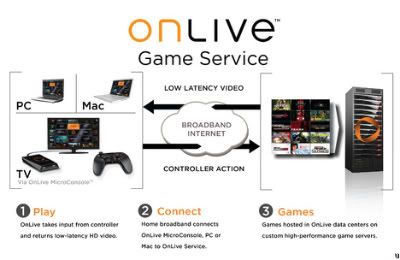
OnLive is a new gaming service, slated to launch towards the end of 2009. The basic idea of OnLive is to make all modern games playable on any system. This involves a lot of rendering, A, and other elements of gameplay being done by servers housed in crazy frozenated buildings. These servers will be hunkered down with multiple processors some of the latest graphics cards known to man.
On your end however you will have a PC or Mac based client, or perhaps, a "MicroConsole" hooked up to your television. Nothing taking up as much room as a George Foreman Grill sized PS3. Imagine something the size of the tiny cable box (the old school kind). This also means no upgrades for you PC people out there.
Perlman has been noted saying "This is the last major console cycle," and also "If not this one, then definitely the next one."
OnLive has been developing proprietary methods of data and video compression over the last 7 years to develop the process of bringing these games to you over a broadband connection and with the prices of Servers dropping like Paris Hilton on who ever has the most money and booze lately it's becoming an idea that could be functional.
With OnLive all game code is hosted on their servers. The players (i.e. - you) will either download a client to their computer (like a browser add-on) but the game will run seperately from the browser. OnLive will also be making a "MicroConsole" available, either for a very low cost or even free, with a contract commitment.
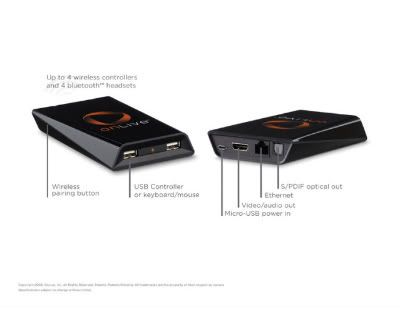
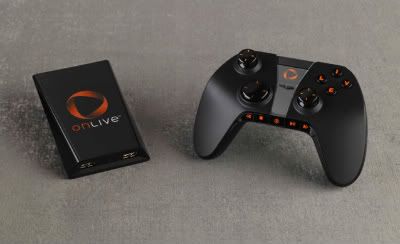
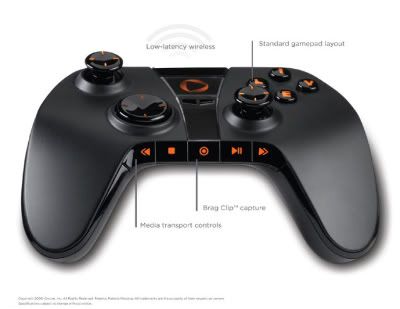
The micro console is about the size of a 2.5-inch USB external hard drive, with HDMI output, gigabit Ethernet jack, and USB ports for I/O (game controllers, keyboards, mice), plus Bluetooth support, mostly for headsets. The micro console ships with a wireless game controller.
Imagine if you will gametap but on a level so complex that it is a bit hard to explain. With all the compression and transfer going on here according to Perlman, the latency of playing a game is at least as good, and usually better than, playing on a LAN, and should be as good as playing on a local PC. Multiple server sites are slated to be created, with hopes of having no gamer be more than 1,000 miles from a physical server.